
Insights • Hosted Thought Leadership
Part of the Strategic Impacts™ Framework by Sherri Monroe • Hosted by AMGTA
Strategic Impacts™ Framework › Strategic Impacts™ Series › Article 5 of 12
Series Progress ●●●●●○○○○○○○

Availability as Strategy
When Access Cannot Be Assumed
By Sherri Monroe • March 2026 • 7 min read
This article is part of the Strategic Impacts™ Series within the Strategic Impacts™ Framework. Each article stands on its own. To get oriented, start with The Strategic Impacts Framework: An Introduction or the Reader’s Guide.
Availability is often discussed as a logistics problem—and when organizations try to solve it as a logistics problem, they typically add redundancy: more suppliers, more inventory, more capacity within the same system. Redundancy duplicates existing structures.
Additive manufacturing offers access, not duplication.
Not duplication within existing logic, but access through a different logic—one less sensitive to volume, location, and sequencing.
The value lies not in having more of the same, but in having an alternative that doesn’t require the same preconditions.
Availability is not simply about whether something is on hand or can be obtained. It reflects the degree to which access depends on assumptions that may no longer hold.
From a strategic perspective, availability describes how exposed an organization is to dependency—on geography, tooling, scale, or sequencing—and how quickly those dependencies become binding constraints.
Where availability is positioned tactically, additive manufacturing functions as an emergency measure. Where it is positioned structurally, it becomes a standing capability.
Additive manufacturing alters availability by changing supply chain structures, not by eliminating them.
Availability, as a Strategic Impact, emerges primarily from Reduced Thresholds and Design Freedom operating at the enterprise level. Reduced Thresholds decouple access from scale requirements. Design Freedom enables alternative pathways that do not simply replicate existing constraints. Together they create access conditions that are less dependent on fixed supplier relationships, geographic concentration, and sequential logistics.
Dependency, Not Disruption
Conventional manufacturing systems infer availability through efficiency. Scale, repetition, and geographic optimization are positioned as proxies for access. These assumptions hold when conditions are stable and predictable. They hold until demand shifts, a key supplier disappears, or a lead time doubles overnight.
Additive manufacturing disconnects availability from these assumptions. It enables production with reduced tooling, without minimum volumes, and without exclusive dependence on centralized locations. This does not replace conventional systems, but it changes the conditions under which access is possible.
A bolt and nut—the kind available at any hardware store, produced by the millions—is often cited as a poor candidate for additive manufacturing. By cost-per-part logic, it is. But on an oil rig, in a copper mine, or at a forward operating base, the absence of that bolt keeps machinery idle. When idle machinery must be abandoned—or destroyed to prevent it from falling into the wrong hands—the cost is no longer the bolt. It is everything the bolt was holding together.
The contrast is visible in how organizations deploy these capabilities.
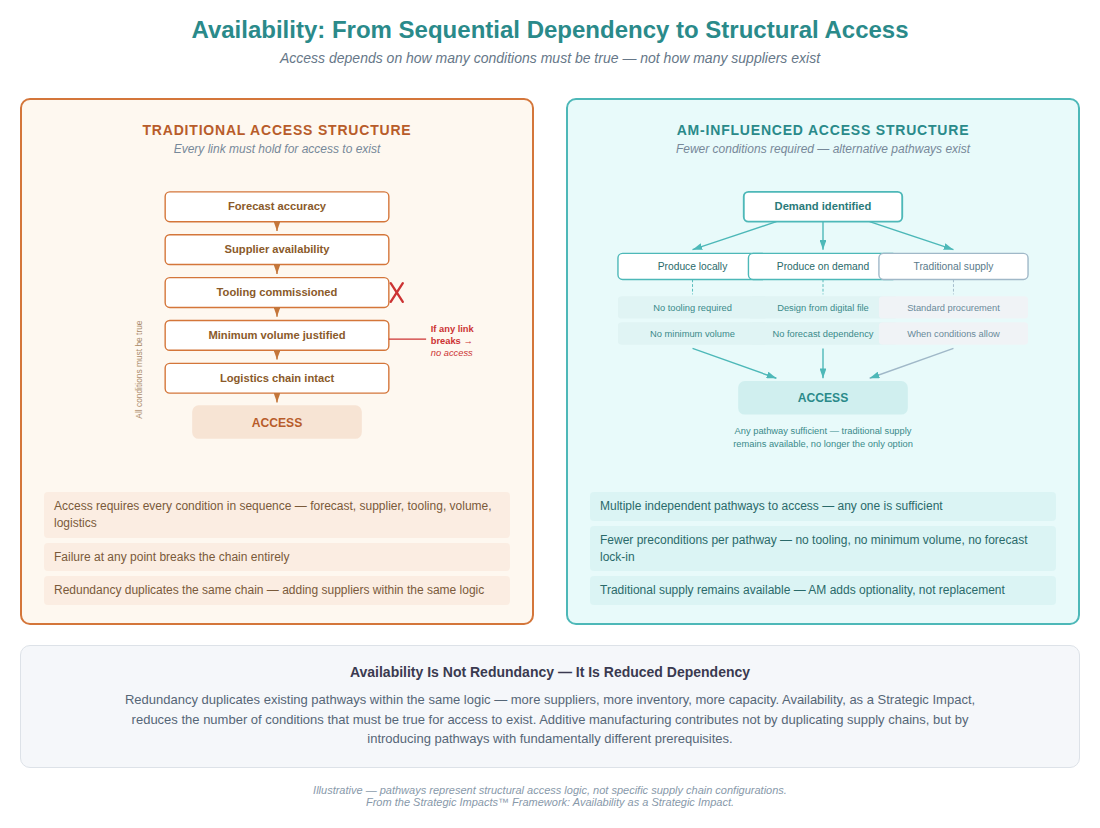
How dependency shifts when availability becomes structural
Organizations may maintain qualified additive processes capable of producing certain components, yet continue to rely almost exclusively on traditional suppliers for availability planning. Additive manufacturing is reserved for exceptions—short runs, urgent replacements, or low-volume spares. In these cases, access remains contingent on the same upstream assumptions: forecast accuracy, supplier continuity, and logistical reliability.
In contrast, organizations that regard additive manufacturing as an availability capability integrate it into baseline access logic. The question shifts. Not how quickly a supplier can deliver—but where production authority resides and how easily it can be exercised. Availability is evaluated not in terms of lead time, but in terms of dependency.
The difference is not technological. It is interpretive.
Availability Beyond Logistics
When additive manufacturing is regarded tactically, it is positioned as a fallback: a way to produce parts when traditional pathways fail. In this role, it is episodic and reactive. In these periods of disruption, additive manufacturing is assigned a difficult task and, even when successful, is viewed as an exception rather than revealing something important. Its value appears and then recedes once stability returns.
When regarded strategically, additive manufacturing influences availability continuously. It reduces reliance on fixed pathways and enables access without requiring the same preconditions. Availability becomes a standing capability rather than an emergency response.
This explains why additive manufacturing’s impact on availability varies so widely between organizations.
Availability Is Not Redundancy
When availability is misunderstood, additive manufacturing strategies often emphasize responsiveness rather than access. Metrics focus on turnaround time or emergency capacity. These measures capture performance under stress, but they do not address whether access depends on fragile assumptions.
This misunderstanding also affects who owns the decision. Availability is frequently managed within procurement or supply chain functions, even though its implications extend to risk exposure and strategic optionality
Availability is distinct from resilience, though the two are often linked.
Resilience describes economic capacity to adapt when conditions change. Availability describes whether access exists without requiring change in the first place.
Organizations that internalize this distinction begin to use additive manufacturing differently. They evaluate where access must be required regardless of demand predictability. Availability becomes something that can be designed, not merely defended.
Availability, when positioned as strategy, not reaction, shifts additive manufacturing from an alternative supplier to an alternative logic of access.
Terms Used in This Article
- Availability — access without dependency on scale, geography, or sequencing; not supply chain redundancy
- Resilience — economic capacity to adapt; distinct from Availability
- Design Freedom — the property from which Availability emerges
- Reduced Thresholds — the property from which Availability emerges
- Optionality — the value of keeping choices open
See all framework terms →
The Strategic Impacts™ Framework is original work by Sherri Monroe, hosted on AMGTA Insights with permission. Originally published at sherrimonroe.com.
About AMGTA Insights
What you’re reading and how AMGTA relates to it
AMGTA Insights publishes thought leadership on additive manufacturing—editorial work AMGTA produces directly, independently authored analysis hosted with attribution, and curated conversations with manufacturing leadership. Hosted independently authored work reflects each author’s perspective. AMGTA hosts work it considers substantive to the discussion of additive manufacturing in resource-efficient manufacturing systems.
Or email info@AMGTA.org
Members shape this work
The analytical content AMGTA hosts—and the conversations it makes possible—exists because members make AMGTA’s work possible. The next sector brief, the next analytical thread, the next reviewed use case: built by members, in working groups, right now.