
AMGTA BRIEF • October 2026
The Holy Grail of Scale
Conventional manufacturing’s constraint quietly became additive manufacturing’s goal
By Sherri Monroe • Executive Director, AMGTA
~5 min read
Scale in manufacturing is about the capacity to produce all that is needed – what is needed, when it is needed, where it is needed, how it is needed. But in many discussions of additive manufacturing, “scale” has come to mean something narrower: replicating the high-volume, produced-in-advance, centralized production that conventional manufacturing’s economics require. Have we inadvertently adopted conventional manufacturing’s constraint as the measure of additive’s maturity?
To reach the lowest possible cost per part — against the heavy fixed costs of tooling, setup, and long lead times — conventional manufacturing needs high volume, enough identical units to absorb those costs. From that volume requirement, the rest follows: production concentrated in one large facility, and parts made common across products so the numbers stay high. High volume, centralization, commonality, production in advance – these are not four goals. They are one constraint.
Additive does not carry those fixed costs, so it does not need any of that. It has little tooling to amortize – so no need for the volume to spread it, no need to centralize, no common part to bundle volume. Measured against that cost structure, additive comes up short – not because it is behind, but because it works on a different economics entirely.
With additive, none of this is forced, so each becomes a decision rather than a requirement. Volume is just volume – the number of parts actually needed, not a figure inflated to justify tooling. Location is a decision, not a mandate to centralize. Commonality is a decision too: where conventional economics push a manufacturer to design one part to serve five products – a lowest-common-denominator design that fits all of them and suits none perfectly – additive can make five parts, each suited to its own product, at no penalty, where conventional would need the combined volume to justify the tooling. And timing is a decision: parts can be made as demand becomes clearer rather than all at once and held.
None of this means high-volume demand is imaginary. If a manufacturer needs 100,000 units, it needs 100,000. But under conventional economics, needing 100,000 is not enough on its own – it still has to find a way to justify the tooling. So it bundles the volume to get there: across products, making one part common to several to lift the combined number; and across time, building the whole run at once rather than as it is needed. Commonality and all-at-once production are the same effect from two levers – bundling volume to clear the threshold. The quantity was real. The bundling around it was the price of reaching that quantity conventionally, not something the demand itself required.
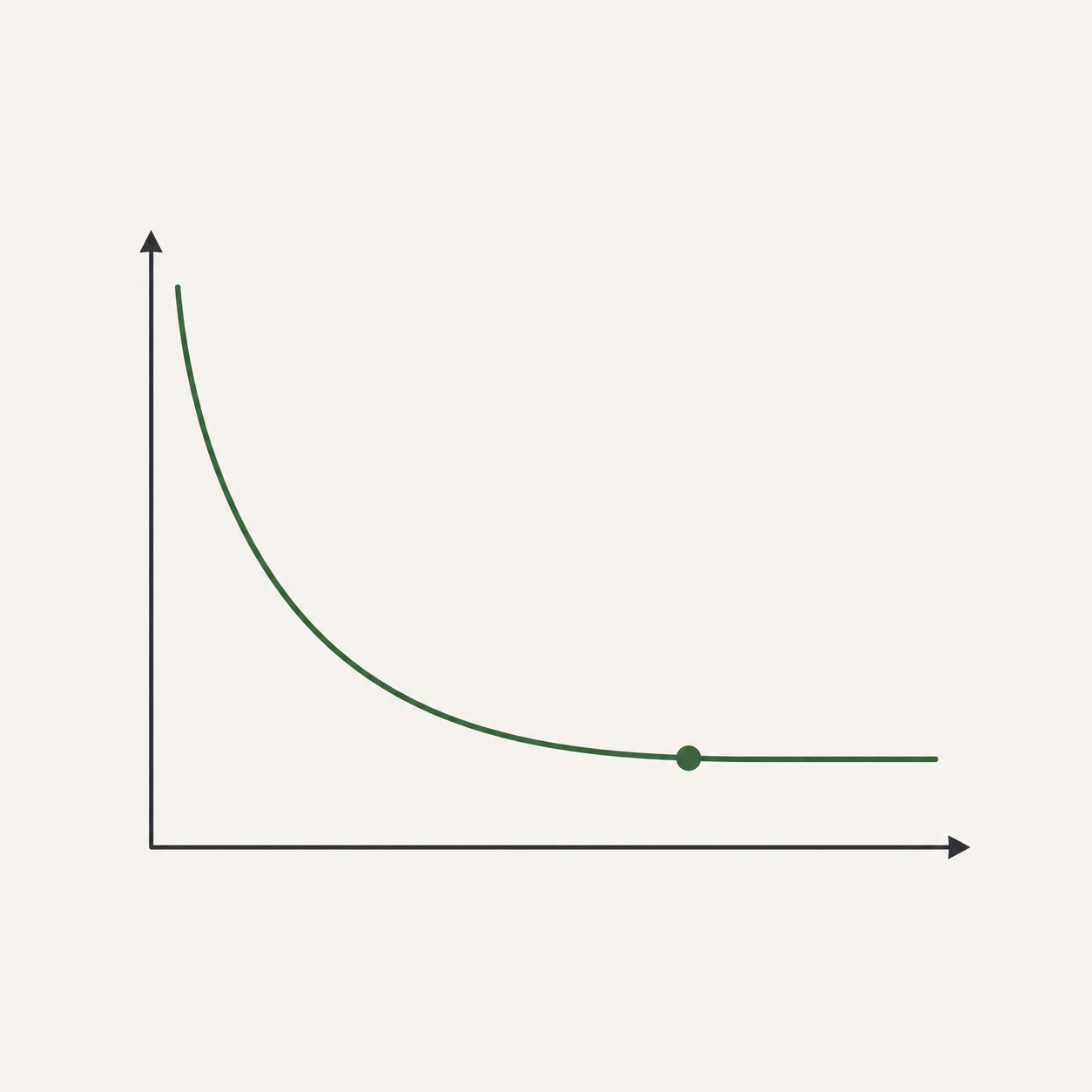
Every manufacturing process has a cost-per-unit curve that falls as volume rises and then flattens – a point past which making more barely lowers the cost of each one. Conventional manufacturing’s curve bottoms out far out, at very high volume; its enormous fixed costs take that many units to absorb. Because that point sits so far out, conventional needs the high volumes to reach its best cost. Additive’s curve flattens early, at a fraction of the volume, because it has little fixed cost to absorb. It reaches its own best cost long before conventional reaches its own. The highest volumes are where conventional breaks even – not a benchmark that transfers to additive.
None of this is an argument against high volume. Plenty of products need vast quantities of one unchanging design, and for many of them conventional manufacturing is the right answer and will stay the right answer. The point is narrower: the things bundled into “scale” – where to produce, whether to make parts common, when to commit – are not laws of manufacturing. They came from conventional’s economics, which additive does not share. Without those economics forcing the answer, each is a decision again – and potentially a strategic opportunity.
The high volumes, the single location, the common design, the run built in advance were conventional manufacturing’s way of coping with its own costs. Treating them as the measure of additive’s maturity judges additive by a standard built for a different process – and misses what additive actually makes possible.
Those are not decisions the production floor makes alone. Where to produce, whether to standardize, when to commit – separated from conventional’s economics, these become open questions, and they belong as much to the people who design products, plan supply, and allocate capital as to the people who make the parts.
Or email info@AMGTA.org
Members shape this work
The analytical content AMGTA hosts—and the conversations it makes possible—exists because members make AMGTA’s work possible. The next sector brief, the next analytical thread, the next reviewed use case: built by members, in working groups, right now.